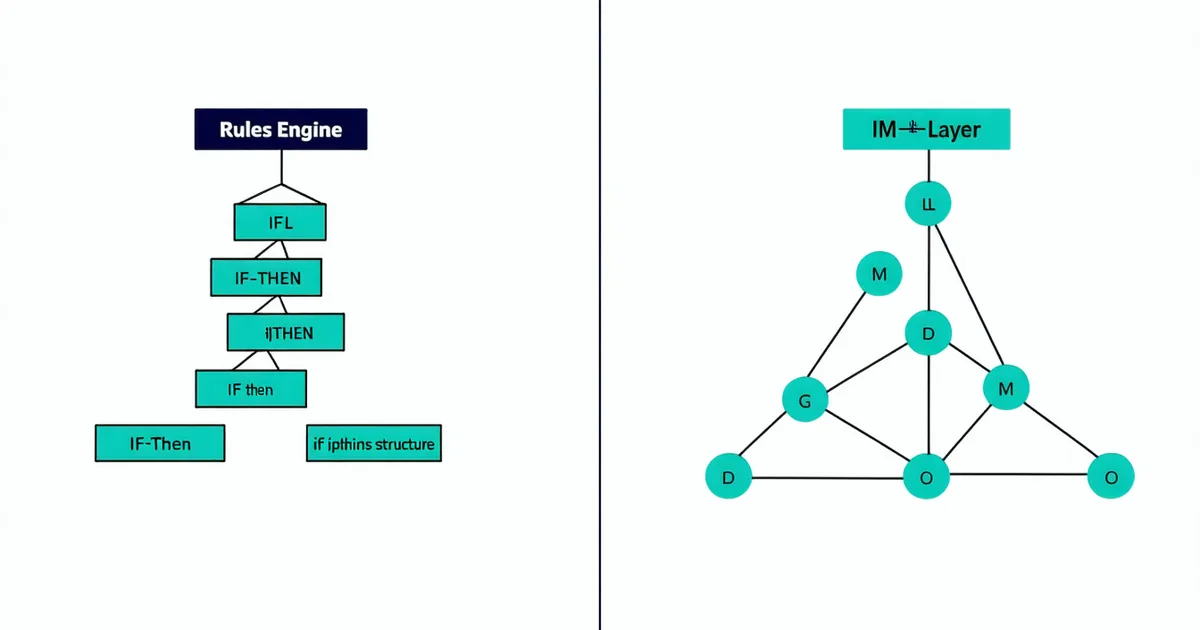
The decision most mid-market credit teams make poorly isn't which model to use. It's which architecture to use. The choice between a rules-based lending (RBL) system and an ML-driven decision layer is often framed as a modernity question — the old way versus the new way. That framing is wrong, and it pushes teams toward architectures that fit the story they want to tell rather than the operational and regulatory realities they actually face.
A structured look at the tradeoffs — across auditability, deployment speed, MRM burden, reason-code stability, and total operational cost — tends to push most mid-market lenders toward a hybrid architecture. But the shape of that hybrid matters as much as the label, and the details of how rules and ML interact determine whether you've built something defensible or something that looks defensible until an examiner asks to see the decisioning logic.
What a Rules Engine Actually Is (and Isn't)
A rules engine in a lending context is a system that evaluates a set of declarative conditional logic — "if DTI exceeds 43% and FICO is below 640, decline" — against application-level inputs and produces a decision. The rules are explicit, auditable, and human-readable. They can be expressed in a decision table format that a credit policy analyst without programming background can read and modify. Deployment of a rule change requires updating the rule, testing it against historical data, getting approval, and deploying — a cycle that, in a well-tooled environment, takes days rather than months.
The operational strength of rules engines is also their operational weakness. They're only as good as the rules a human analyst can write. When the true risk-to-feature relationship is nonlinear — when the combination of a 680 FICO score, a 39% DTI, and a 14-month employment history is more predictive of default than any individual threshold would suggest — rules don't capture that interaction. You'd need a combinatorial explosion of rules to approximate what a model can learn from training data directly. The practical limit of a well-maintained lending rules policy is typically 40 to 80 active rules before maintenance complexity starts creating more risk than it prevents.
A Pareto analysis of adverse action reason codes at any mid-market lender typically reveals that the top 4 to 6 rules account for 70 to 80% of hard declines. Those high-frequency rules are the ones worth getting exactly right — the places where the explicit declarative statement of the lending policy has the most impact. Those are also the rules where ML adds little, because the pattern is already well-understood and the policy is already precise. ML adds value in the tail — the 20 to 30% of decisions where multiple marginal factors interact in ways that rules don't capture cleanly.
What ML Adds — and the MRM Time Cost
An ML decision layer learns risk-to-feature relationships from historical origination and performance data. A well-trained model on a relevant population will generally produce a higher KS statistic — better rank-ordering of risk — than an equivalent rules-based system, particularly in near-prime and subprime segments where applicant risk profiles are heterogeneous and threshold-based rules leave significant performance on the table.
The MRM cost of an ML model is real and should be part of the architecture decision. Under SR 11-7 and OCC 2011-12, a model used in a consequential credit decision requires initial validation before deployment and ongoing monitoring throughout its production life. For a mid-market lender, a full initial validation of a custom ML model typically runs 3 to 6 months from final model specification to validation committee approval. That's the time-to-deploy cost that makes ML architectures feel slower than they are. The model might train in a week. The governance path to production is what takes months.
We are not saying that ML models aren't worth the validation investment. We are saying that the validation timeline is a real cost that should be included in the architecture decision — and that an ML model deployed without completing that cycle, regardless of how good its performance looks in testing, creates MRM liability that tends to surface at the worst possible time: an examination, a model-driven loss event, or a fair lending audit.
Reason-code stability across model versions is a related consideration that rarely gets enough attention in the ML-versus-rules debate. When you update a rules engine, the reason code implications of each rule change are transparent — you added a threshold, you know which applications are now being declined for a new reason. When you retrain an ML model, the top adverse action reasons can shift across the entire applicant population in ways that aren't immediately visible. An application that was declined for "derogatory account history" under model version 2.1 might be declined for "high utilization of revolving credit" under version 2.2 — not because the applicant changed, but because the model's feature relationships shifted on retraining. If your adverse action notice generation is keyed to the model output, those shifts propagate to the notices. That's a Reg B compliance consideration, not just a model management nuisance.
The Hybrid Architecture: Where the Logic Lives Matters
Most credit risk practitioners who've thought carefully about this problem end up in the same place: hard knock-outs and high-frequency policy decisions stay in declarative rules; the scoring and ranking layer is ML or scorecard. The reasons are both operational and regulatory.
Hard knock-outs — bankruptcies within a defined look-back period, active garnishments, identity fraud flags, regulatory exclusion lists — are not scoring problems. They're policy decisions that the credit committee has made explicitly and that need to be enforced consistently, with no probability-based exception handling. These belong in rules. Any ML model that incorporates these signals as features rather than hard gates is introducing model uncertainty into a domain where certainty is required.
The grey band — applicants who pass the knock-outs and fall into the range where marginal risk differences matter — is where ML adds genuine value. A gradient-boosted model or a well-calibrated scorecard trained on the lender's own origination and performance data will rank-order that population better than any threshold-based rule system can. The adverse action reason codes from the scoring layer cover this population appropriately when the attribution is done at the application level, not the population level.
The implementation question for a hybrid architecture is where the rules layer executes relative to the scoring layer. The defensible sequence for most mid-market lenders: hard knock-outs fire first, as blocking conditions that prevent the application from even reaching the scoring layer. If the application passes knock-outs, the scoring layer runs. If the application falls below the primary score cutoff, the primary score's reason codes govern the notice. If the application passes the primary score but a secondary rule condition (DTI ceiling, LTV limit, employment tenure minimum) causes a decline, the rule condition governs the notice.
Documenting that sequence — which conditions fire in which order, and which layer's output governs the adverse action reason codes — is what makes the hybrid architecture defensible in an MRM review and in an examination.
Rules-First vs. ML-First: The Real Decision Factors
For an auto-finance shop operating across 18 states with approximately 45,000 originations per year, the architecture question isn't primarily about raw model performance. It's about three operational constraints: time-to-policy-change, compliance documentation burden, and the technical capacity of the risk team.
If the credit policy team needs to respond to a state-level regulatory change in 30 days — tightening DTI caps, updating employment verification requirements — a rules-first architecture with a good rules management layer can do that without touching the ML model. The rule changes are tested, approved, and deployed within the compliance deadline. An ML-first architecture that embeds these policy constraints as training-data features can't update that quickly; the model has to be retrained and revalidated, which runs 3 to 6 months.
If the risk team's primary concern is lift on a thin-file near-prime population where their current rules-based approval rate is leaving money on the table, ML adds more value than additional rules. But that lift needs to be validated against the lender's own performance data — a model trained on a different lender's near-prime auto portfolio may not generalize to a lender whose geographic concentration, LTV distribution, or income verification standards are materially different.
The architecture evaluation question worth asking explicitly: what percentage of your declines come from hard policy rules, and what percentage come from marginal score-band uncertainty? If 70% of your declines are clean knock-outs — clear policy violations — you have a rules problem more than a scoring problem. More ML won't meaningfully improve that. If 40% of your declines are in a narrow score band where you're genuinely uncertain which applicants will perform, ML has real work to do.
Deployment Cost and the Year-Long Project Problem
The year-long project risk in credit decisioning architecture usually comes from three sources: data integration complexity, model validation cycle time, and the organizational approval chain for a significant credit policy change. None of those are inherent to the ML-versus-rules choice — they're process and governance problems that exist regardless of architecture.
The practical path for a mid-market lender that doesn't want to start a year-long project: deploy rules first into a managed decision layer, where the rules are explicitly documented, tested, and version-controlled. Get the compliance documentation on the rules in order — the decision table, the adverse action reason code mapping, the policy approval log. Then add the scoring layer in shadow mode, running against the same production traffic as the rules layer but not influencing outcomes. Validate the scoring layer against the shadow-period performance data. Promote the scoring layer to augment — not replace — the rules layer's grey band decisioning.
That sequence compresses the year-long project into a more manageable timeline because each phase has a discrete, documentable outcome. The rules layer is compliant and producing decisions from day one. The shadow phase generates the performance evidence the validation committee needs. The augmentation promotion is scoped — it doesn't require rebuilding everything at once. And at each stage, the adverse action notice generation is accurate, because the decision layer was built with reason-code attribution as a first-class function, not an afterthought.